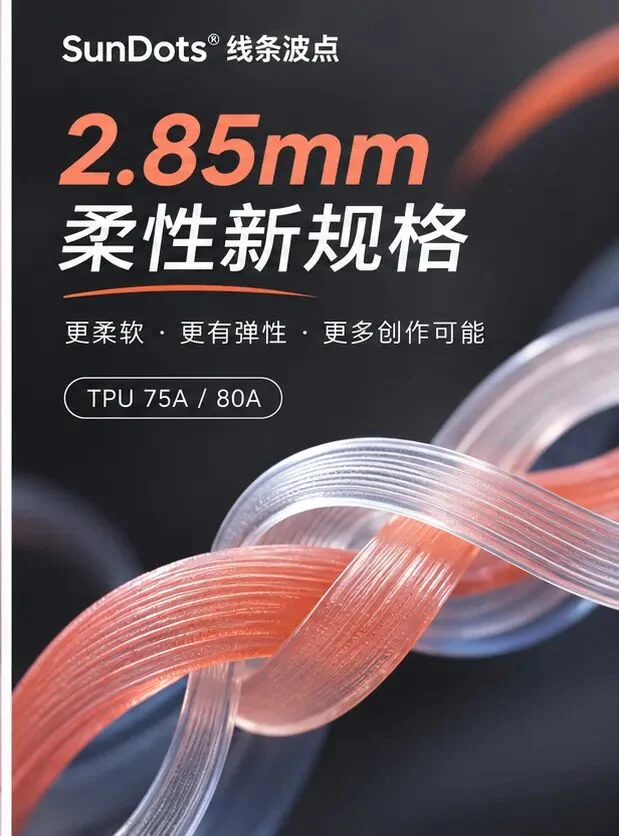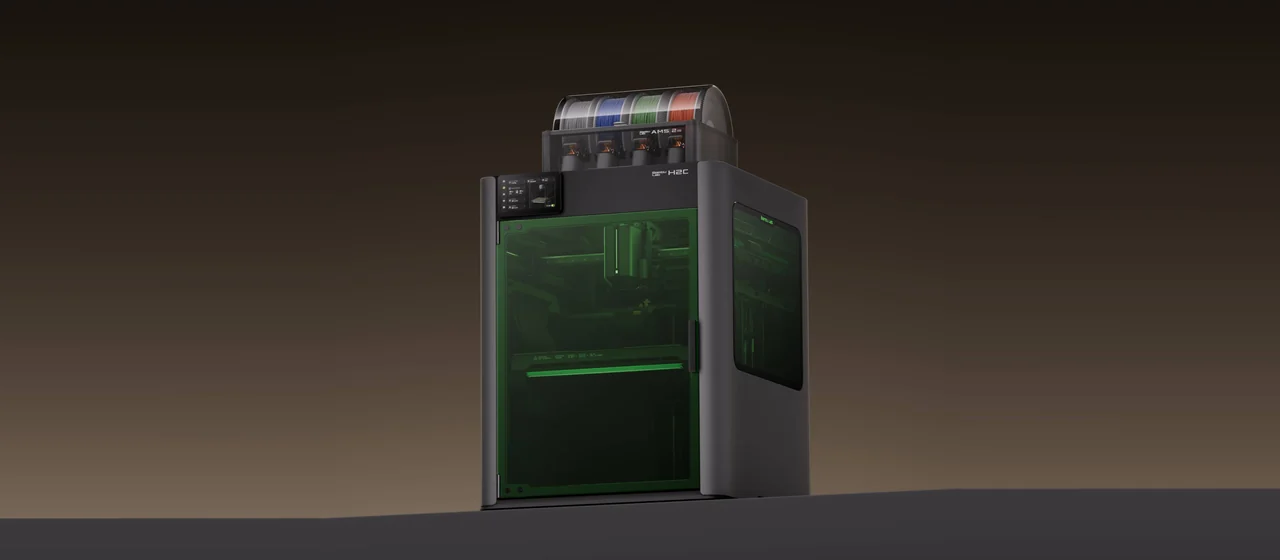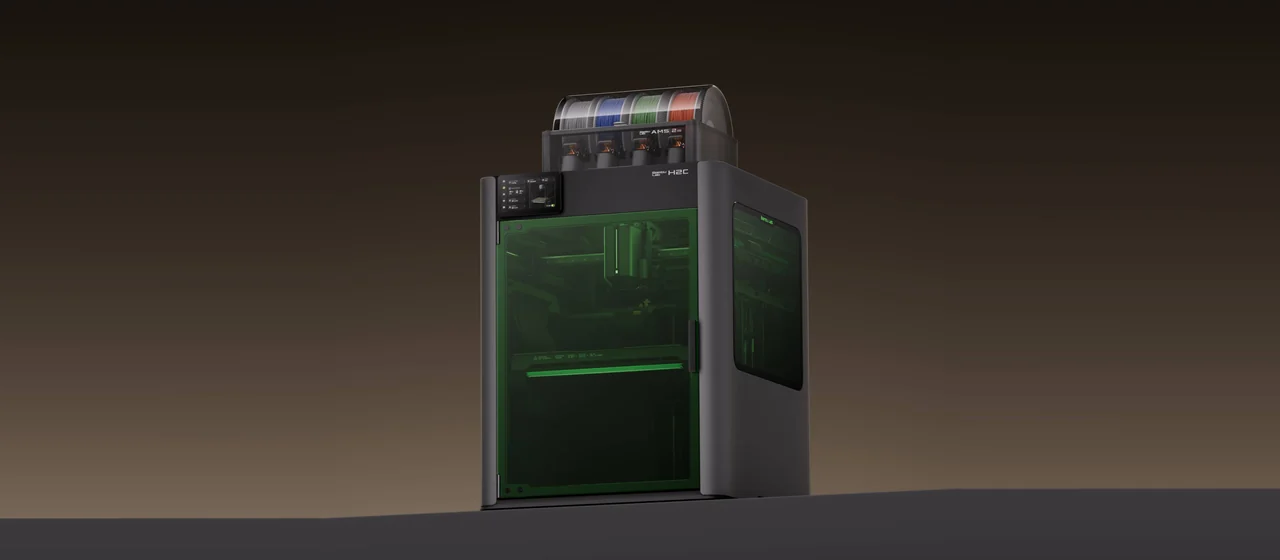
Sundots 2.85 mm flexible filament has launched, is compatible with the Bambu Lab H3C, and is open for purchase orders, including bulk. Most desktop printers of the last few years are built around 1.75 mm filament. 2.85 mm, which people still call 3 mm in conversation, never left. Professional machines such as the UltiMaker S series still specify it, and Bambu Lab has used 2.85 mm for an ultra-soft TPU 75A spool sold only for the H3C. For TPU and TPE, diameter is a feeding decision before it is a catalogue decision.
Two diameters, two different feed paths
1.75 mm is the diameter on most current desktop FFF printers. Bowden tubes, extruder gears, and spool holders were designed around it, which is why the everyday material choice is wider at 1.75 mm.
2.85 mm is the other common nominal size. Casual speech still says 3 mm for this class. The number that matters is the diameter and tolerance in the printer manual. A spool marked 2.85 mm is not automatically safe in a path built for 1.75 mm.
Which printers still specify 2.85 mm
UltiMaker’s S8 product page is a current example of a professional printer specified for 2.85 mm filament. If you keep an S-series machine, the replacement spool has to match that path. Check the manual of the machine you already own.
Bambu Lab’s US store lists TPU 75A (2.85mm) as compatible only with the H3C, with a stated diameter of 2.85 mm ± 0.05 mm. That is one official soft-filament spool, published ahead of the 3 November 2026 launch. It is not a finding that desktop printing is leaving 1.75 mm. Full H3C material rules were not public on 2 November 2026 and are expected with the launch specification.
What changes for soft TPU and TPE
Flexible filament fails in the feed path more often than the nozzle discussion suggests. A soft column buckles. A larger diameter stiffens that column quickly, because the buckling load of a round rod scales with the fourth power of diameter when length and material modulus stay the same. From 1.75 mm to 2.85 mm that geometric factor is about 7, and the cross-section is about 2.65 times larger. Those figures are geometry, not a hardness test.
The rest of the path is the tradeoff. A thicker filament needs a wider tube and a larger bend radius. Brittle filament is more likely to snap on a tight bend. At the same volumetric flow the thicker filament moves more slowly, which can be kinder to a soft grade and is still not a speed rating for your printer.

| Question | 1.75 mm | 2.85 mm |
|---|---|---|
| Feed stiffness on very soft TPU | Thinner column, buckles sooner if the path is loose | Thicker column, higher theoretical buckling load |
| Same volumetric flow | Higher filament speed | Lower filament speed |
| Bend inside a tube | Tighter bends are easier to package | Needs a larger minimum bend radius |
| Buying the spool | Wider everyday choice on desktop machines | Fewer grades, and only where the printer specifies it |
Choose the diameter the printer specifies
Start from the manual, not from a wish for a softer grade. If the printer, the extruder, and the holder are built for 1.75 mm, buy 1.75 mm. If they are built for 2.85 mm, buy 2.85 mm. Forcing the other diameter is a machine problem, not a slicer setting.
On an enquiry, write the printer model, the diameter, the tolerance you need, and whether the part is a wearable, a seal, or a general flexible piece. Hardness still matters, but a Shore number does not fix a mismatched diameter.
- Read the diameter in the manual for the path you will use.
- Match spool width and hub to the holder.
- Ask for the technical sheet of the exact grade, not a family name alone.
- Keep a drying step in the plan for TPU and TPE.
Drying and storage for flexible filament
Soft TPU and TPE take up moisture. Wet filament shows up as bubbles, stringing, or an inconsistent line. Bambu Lab’s own TPU 75A (2.85 mm) listing tells the buyer to dry that spool before use. For any other grade, follow its technical sheet rather than a temperature copied from a different brand.
Keep the spool sealed, with desiccant, and dry it again after it has sat open in a humid room. Changing diameter does not replace that habit. Follow the technical sheet for the grade you buy.
Questions on 2.85 mm and 1.75 mm flexible filament
Is 2.85 mm the same as 3 mm filament? In casual speech, people use 3 mm for this class. When you buy, match the nominal diameter and tolerance the manual asks for. Do not assume two labels are interchangeable.
Which printers use 2.85 mm? The UltiMaker S8 page specifies 2.85 mm filament and is a clear current example. Some other professional machines do too. Check the manual of the machine you own. Do not infer an H3C rule from the UltiMaker page.
Which diameter is better for TPU? For an ultra-soft grade, 2.85 mm resists buckling more, which is a reason a vendor may choose it. For a printer built only for 1.75 mm, 1.75 mm is the diameter that can feed. Better means the diameter that matches the path.
Can Sundots supply 2.85 mm TPU or TPE today? Yes. Sundots 2.85 mm flexible filament has launched, is compatible with the Bambu Lab H3C, and is open for purchase orders, including bulk. Send us an enquiry for pricing, lead times and available hardness options. Flexible grades already in the catalogue are a separate range.
Sundots 2.85 mm flexible filament for the Bambu Lab H3C
The published Sundots flexible range, including the TPU and TPE grades from WTCC 2026, stays as it is in the catalogue. The 2.85 mm flexible filament is a separate launch: it is compatible with the Bambu Lab H3C and open for orders. For an UltiMaker or another printer, match the diameter in that machine’s manual.
To order Sundots 2.85 mm flexible filament for the Bambu Lab H3C, use the contact form and name the printer and the diameter. A bulk enquiry uses the same form. Bambu Lab, H3C, and UltiMaker are named only to identify machines and a public listing.
Order Sundots 2.85 mm filament for the Bambu Lab H3C
Sundots 2.85 mm flexible filament is launched and compatible with the Bambu Lab H3C. Purchase orders are open, including bulk. Use the contact form on this site to send an enquiry. Send us an enquiry for pricing, lead times and available hardness options.
Sources
Bambu Lab, H3C, and UltiMaker are trademarks of their owners. Sundots is not affiliated with, sponsored by, or endorsed by them. Names identify machines and public pages only. The buckling comparison is geometry, not a laboratory result. Confirm the printer manual before you order a diameter.