
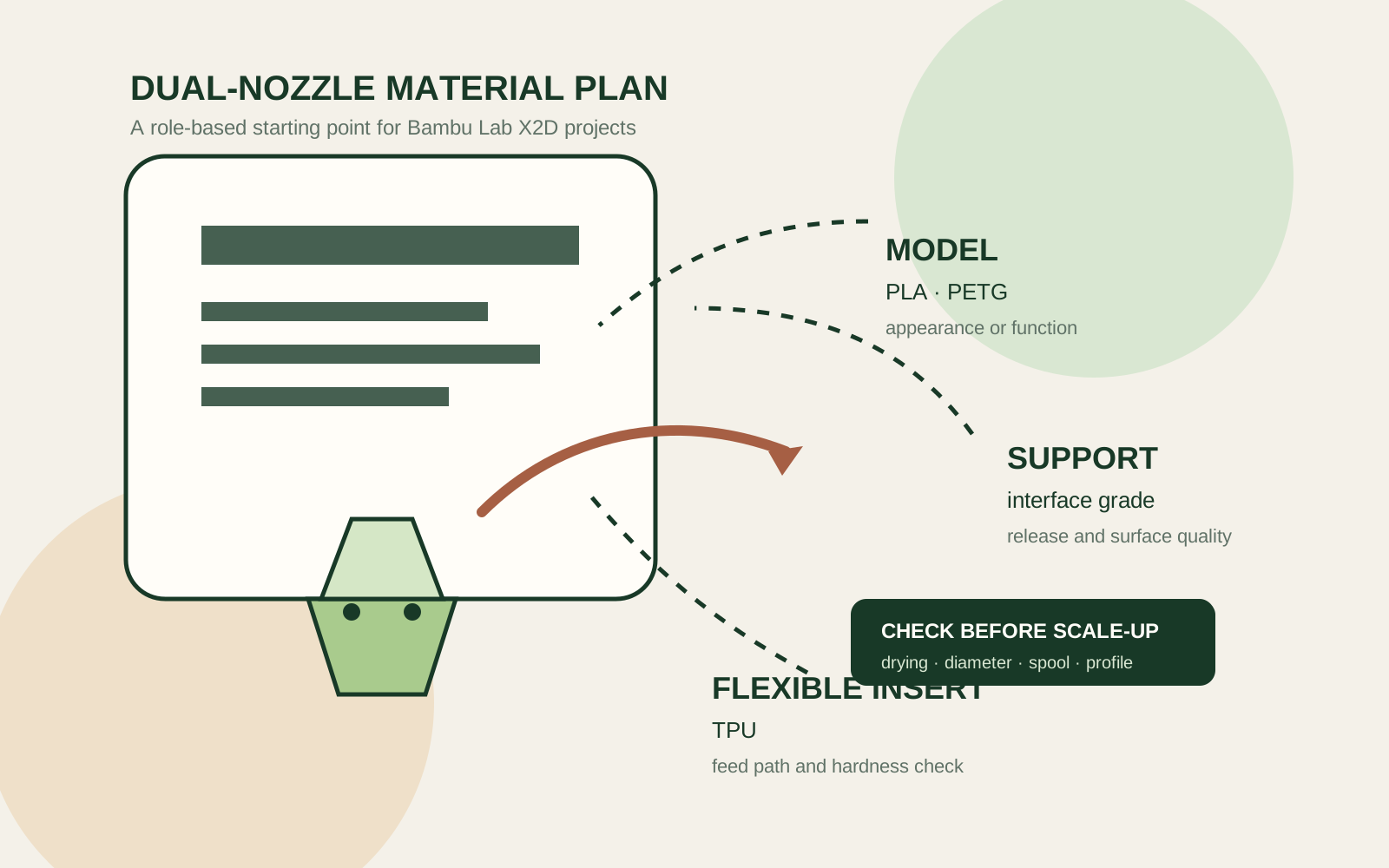
A dual-nozzle printer changes the material question from ‘which filament is best?’ to ‘which filament should do which job?’ Bambu Lab’s official X2D materials describe a model extruder and an auxiliary extruder that can be assigned different roles in one print. That makes the printer interesting for support-heavy parts, but it does not make every pair of filaments automatically compatible.
What the X2D dual-nozzle layout changes
Bambu Lab describes the X2D as a dual-extrusion system: the main extruder prints the model while the auxiliary extruder can handle support or a second material. The official technical explanation describes a direct-drive main extrusion path and a rear Bowden-fed auxiliary path. In practice, the useful benefit is role separation: a model material can stay focused on appearance or part performance while the support material is chosen for release and cleanup.
Treat the X2D name as a printer configuration, not as proof that any two spools can be combined without testing. Nozzle temperature range, drying history, feed path, build surface, purge behavior and the geometry of the part still decide whether a pairing is practical.
Give PLA, PETG and TPU different jobs
PLA is a sensible first trial for detailed models, colour-led prototypes and visible surfaces. PETG is often considered for parts that need more toughness or everyday handling. TPU is the flexible option for bendable features, grips and compliant sections, but it needs a controlled feed path and a grade-specific profile.
For a dual-nozzle project, write the role before choosing the spool: model, support, interface layer, flexible insert or visual accent. A PLA model with a dedicated support material may be easier to validate than a full two-material colour experiment. A PETG part with TPU details may be useful for a prototype, but the interface and cooling conditions need a representative test.
| Print role | Material to trial | Verify before scale-up |
|---|---|---|
| Detailed visible model | PLA | Surface finish, detail and colour consistency. |
| Functional prototype | PETG | Fit, deformation and working conditions. |
| Flexible insert or grip | TPU | Hardness, feed path, speed and recovery after flexing. |
| Support or interface | A compatible support grade | Release, interface quality and waste in the exact geometry. |
Plan support material around release, not colour
Support material is a process choice. The best candidate is the one that gives the required interface quality and removes cleanly under the printer’s current profile. A visually contrasting spool can help inspection, but contrast alone does not make a support material suitable.
Start with a small overhang and interface coupon that includes the same layer height, cooling and contact conditions as the real part. Record the support grade, nozzle assignment and removal result. If the X2D profile or firmware changes, repeat the coupon rather than assuming the previous result still applies.
- Print a support coupon before a large multi-material job.
- Check the interface surface and removal force.
- Record purge, wipe and failed-print observations.
- Keep the approved profile with the exact grade and batch.
Check drying, diameter and spool handling
PLA, PETG and TPU do not share the same moisture sensitivity or conditioning routine. Keep each spool sealed with desiccant and follow the current technical sheet for the grade you are testing. TPU in particular deserves a fresh storage and feed check because moisture and a loose path can show up as inconsistent extrusion or stringing.
Before ordering a larger batch, confirm the filament diameter tolerance, spool dimensions, winding quality and whether the physical spool fits the chosen holder. Bambu Lab’s printer and accessory documentation should be treated as the authority for current hardware limits; a third-party spool that fits mechanically may still need a different profile.
A practical X2D filament buying checklist
A good first order is a controlled comparison, not a pile of unrelated colours. Choose one model grade, one support or interface candidate and one flexible grade only when the part actually needs it. Ask for the material data sheet, recommended profile and a sample plan for the intended printer.
- Name the printer, nozzle setup and firmware version.
- Describe the model, support and flexible-material roles.
- Confirm diameter, spool size, winding and storage condition.
- Print a representative part and a support interface coupon.
- Keep the successful profile, sample and batch reference together.
References & further reading
Printer architecture and role descriptions are based on Bambu Lab’s official X2D pages linked above. SunDots does not claim that every third-party spool, material pairing or support workflow is validated on every X2D firmware release.


